Ostia isn’t really a separate town. It’s part of Rome. It was independent until 1976 when Rome’s continued growth toward the Tyrrhenian Sea absorbed Ostia through an administration restructure. It was already connected to the city through transportation, housing and services. It is only a 37-minute direct train ride from Rome. Thus, Ostia’s population of 92,000 people is part of Rome’s official metro population of 4.2 million. It is a suitable neighborhood for Rome as it’s Romans’ closest and easiest beach. It is filled on weekends.
Ostia should not be confused with Ostia Antica. That is the name of Ancient Rome’s old port which is three miles northeast of Ostia. Located at the mouth of the Tiber River (“Ostia” comes from the Latin word ostium meaning “mouth”), Ostia Antica was where Rome ruled the sea as early as the 2nd century B.C. The town of Ostia was refurbished into a beach town by Benito Mussolini in the 1920s.
Ostia’s port has more than 800 boats.
Ostia: Villa Papagni.
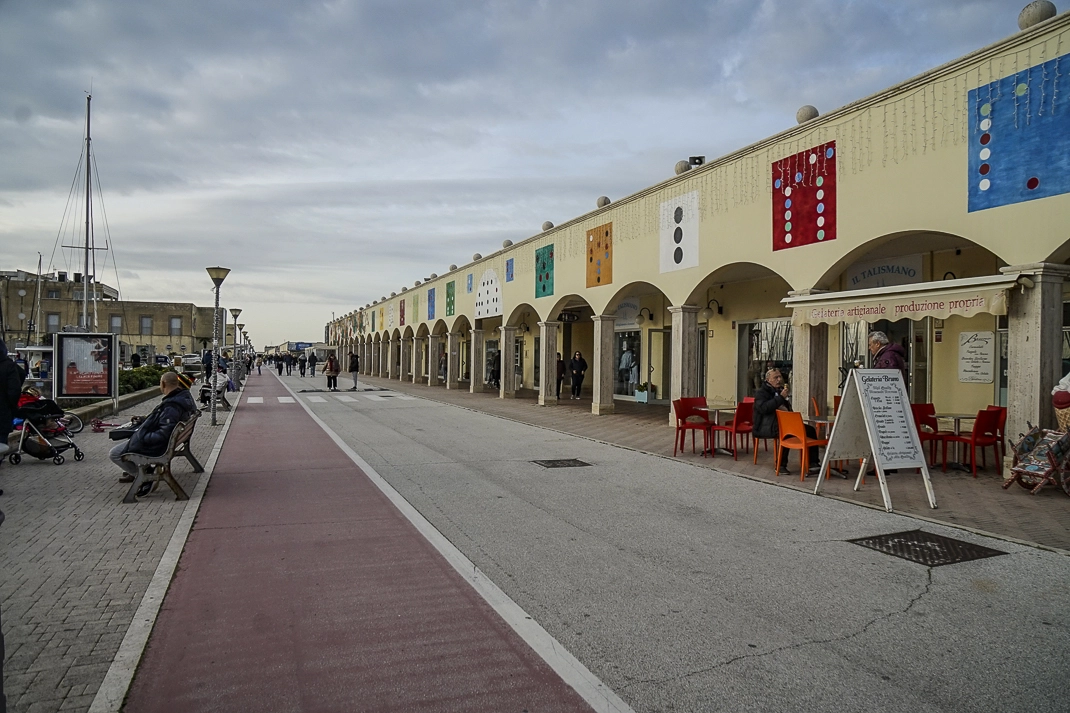
Ostia: Piazza dei Ravennati.
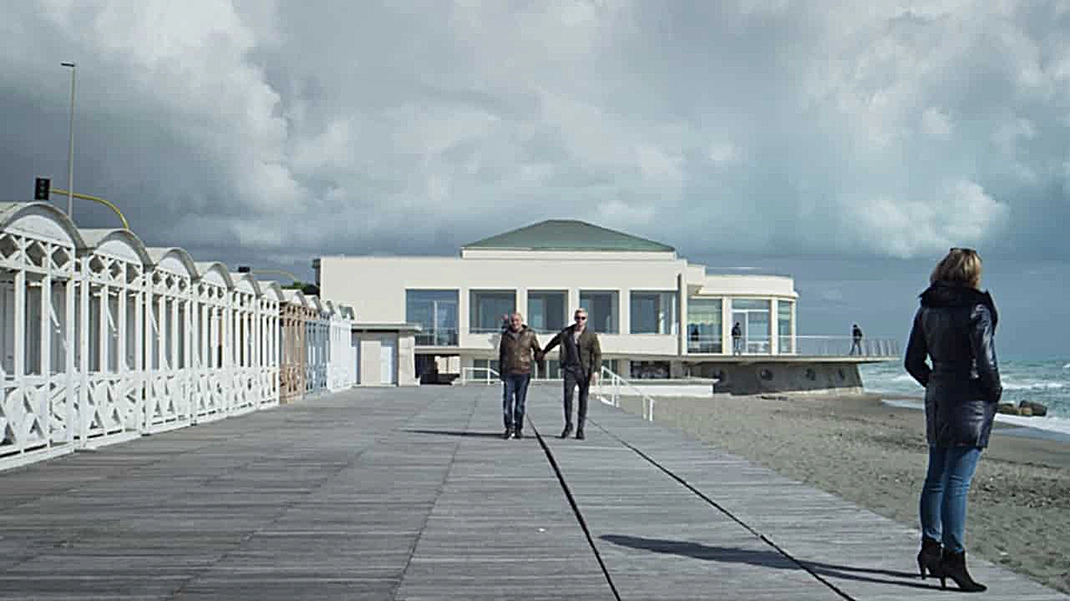
Ostia: Lovers hanging out at Ostia’s beach.
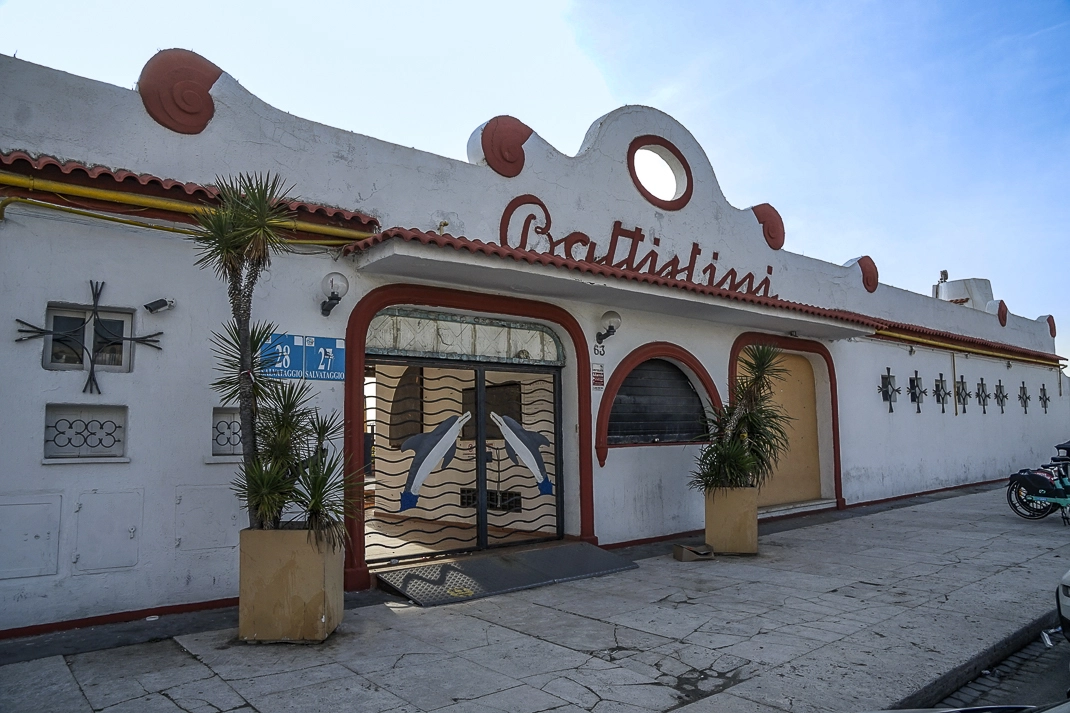
Ostia: Battistini, a historic beach resort in Ostia Lido
Things to do
1 • The beach. Known locally as the lido, Ostia’s beach stretches six miles (10 kilometers). It isn’t as picturesque as other Lazio beaches such as Sperlonga or Santa Marinella. The water isn’t as clear.
The palm trees are set way back by the main road of Lungomare Duca degli Abruzzi The sand is gray. A host of ugly change rooms occupies a large space. But the beach is functional. The sand has nary a pebble and there’s plenty of space to lay a beach towel. A long, wide boardwalk runs along Duca degli Abruzzi.
All day joggers, strollers and roller bladers go up and down. A pier stretches hundreds of feet over the water where you can hang out with street musicians and sunglass salesmen and just stare at the calm sea. Across the street from the beach are two beautiful buildings: Villa Papagni, looking very regal in bright beige with maroon shutters, and another building of five decks of different length like a cruise ship.
Walk to nearby Piazza Anco Marzio and have a krapfen, a round puffy pastry filled with warm chocolate and covered with sugar which the pasticceria Paglia has been selling since 1935.
Ostia’s beach isn’t beautiful but it’s functional and easy to reach.
Ostia: a statue of Neptune near Ostia’s pier.
Ostia: Krapfen at Paglia.
2 • The port. Continue north along Duca degli Abruzzi until you see a port crammed with pleasure craft. Ostia’s port holds more than 800 boats, all protected from the sea by a rock jetty.
The port is lined with restaurants and cafes to hang out and watch the boats come in and out from the sea. Have a glass of wine at SR Sailing, an elegant wine bar. Have a gelato at Bruno.
Have lunch at Sotto Vento. Try to ignore the local zone’s housing. It’s a series of rundown apartment buildings, most of them designed for public housing.
Ostia’s port has nany places to drink, eat and shop.
Five stops on the train before Ostia’s main station at Cristoforo Colombo is Ostia Antica. It was established in the 4th century B.C. as a fortified military camp and drew many wealthy from Ancient Rome. In the 2nd century A.D. it had a population of 50,000.
But the Goths invaded it in 410 A.D. and by the 9th century it had been abandoned. Through archeological digs, the ruins of a remarkable area of Ancient Rome were revealed. Over a five-mile (9-kilometer) area are two- and three-story villas, from the top of which you get a great panoramic view of the site.
There are remains of old stores, a public toilet and the beautiful Terme di Nettuno with elaborate mosaics. Today the town of Ostia Antica has 10,500 people and the picturesque Piazza della Rocca which was featured in Episode 4 of Season 5 of Netflix’s “Emily in Paris”.
Ostia: Parco Archeologico di Ostia Antica
Ostia: Parco Archeologico di Ostia Antica
Mafia Capitale: Ostia’s dirty, well-known secret
While the Camorra in Campania, the Cosa Nostra in Sicily and the ‘Ndrangheta in Calabria get more attention, Rome’s own mafia clan has made its share of headlines.
The Mafia Capitale has its headquarters in Ostia and its fierce reputation gave Ostia the nickname Mafia-by-the-Sea. In 2017, clan leader Roberto Spada was filmed headbutting a TV journalist and bloodying his face. In 2022, Italy’s Supreme Court confirmed the Spada clan’s presence and that the group practiced intimidation, subjection and omerta’, the mafia’s term for silence.
In 2011, numerous murders gave Mafia Capitale control of much of Ostia. In 2013, 50 were arrested in a police sweep. Aided by gaps left by political failures, the clan still controls beach concessions, restaurants and gaming machines.
The mafia’s presence in Ostia became more notorious in the hit Italian TV series “Suburra, Blood on Rome”. Running from 2017-2020, it depicted the ofte violent struggle between young mafia power brokers, gypsy clans, the Vatican and corrupt politicians in trying to secure a stronghold in Rome’s beach community.
Where is it:
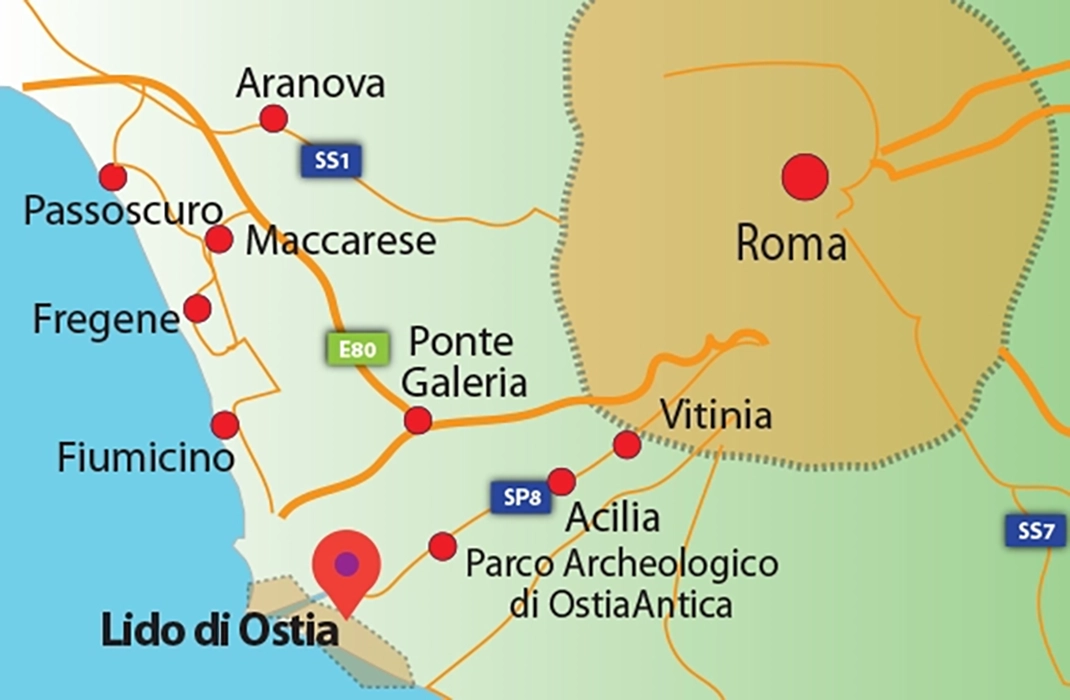
17 miles (28 kilometers) southwest of Rome.
How to get there: Metromare train leaves Porto San Paolo station in Ostiense for Ostia’s Cristoforo Colombo every 10 minutes. The
Sergio & Serra, Via Rutilio Namaziano 10, 39-06-567-2609,
12:30-3 p.m., 7:30-11 p.m. Wednesday-Monday. A typical old Rome restaurant.
Established in 1930, it’s loud, crowded and busy. But it features great fresh seafood with seafood pastas starting at €10 and fish dishes starting at €13.